

The daily bottleneck every pharmacist knows
A typical pharmacy receives two to five distributor deliveries per day. Each invoice lists 15 to 30 line items, and every line carries a product name, batch number, expiry date, quantity, MRP, purchase price, and discount. Entering all of this by hand takes 10 to 20 minutes per invoice — longer if the handwriting is poor or the format is unfamiliar.
This is not just slow. It is where mistakes enter the system. A transposed batch number means the wrong batch gets flagged for expiry. A misread expiry date — "03/27" entered as "03/28" — means stock that should have been returned stays on the shelf an extra year. A wrong quantity means the shelf count never matches the system.
What AI invoice scanning actually does
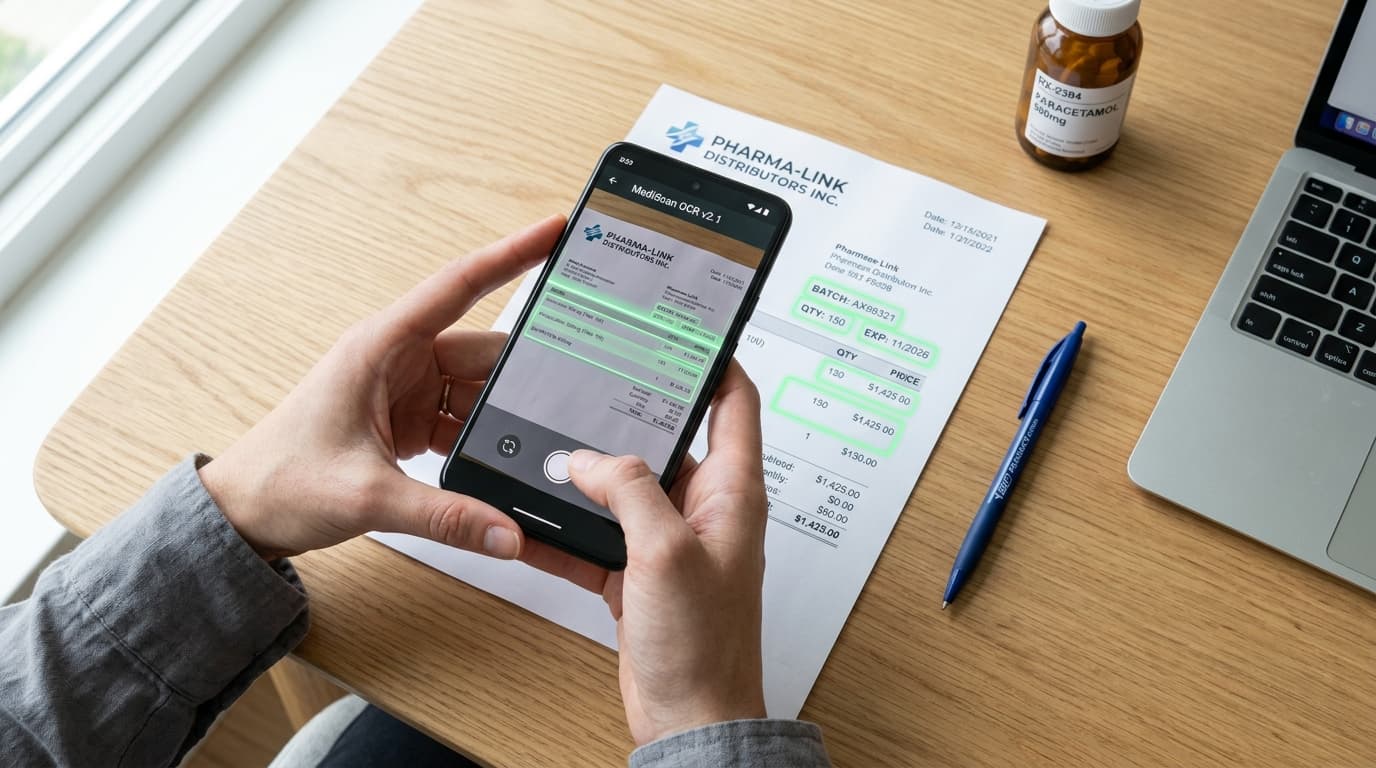
AI-powered invoice scanning replaces the typing step with a photograph. The process works in three stages:
Stage 1: Capture
The pharmacist or staff member takes a photo of the distributor invoice with their phone camera. The image is uploaded to the system — no special scanner, no desktop computer, no flat surface required. Most invoices photograph well even under pharmacy counter lighting.
Stage 2: Extraction
The AI reads the image and identifies each line item. For every row, it extracts:
- Product name (as printed on the invoice — which may differ from your catalogue name)
- Batch number
- Expiry date
- Quantity and free units
- MRP and purchase price
- Discount and tax
This extraction uses a combination of optical character recognition and language models that understand invoice layouts. The system learns from every invoice it processes: if a distributor always prints the batch number in the third column, the model remembers that layout for next time.
Stage 3: Matching and confirmation
Extracted line items are matched to products in the pharmacy's existing catalogue. When the invoice says "AZEE 500 TAB" and the catalogue lists "Azithromycin 500 mg (Cipla)", the system suggests the match based on past mappings. Over time, these mappings become automatic.
The result is presented as a draft stock-in entry: every line item, every field, pre-filled and ready for review. The pharmacist checks the numbers against the physical delivery, confirms or corrects any mismatches, and approves the entry. Stock is updated in one tap.
Why this matters beyond speed
Accuracy compounds
A pharmacist who enters 20 invoices a week manually will mistype something in at least a few of them. Over a month, those errors — a batch number off by one digit, an expiry month wrong — accumulate into inventory records that do not match reality. AI extraction makes the same kind of mistake occasionally, but it makes them consistently, which means the review step catches them. Humans make different mistakes each time, which makes them harder to spot.
It removes the training barrier
In many pharmacies, only one person knows how to enter stock correctly. When that person is away — sick leave, a family event, a day off — deliveries pile up or get entered badly. Scanning reduces the skill required: anyone who can take a photo and check a list can receive a delivery.
Distributor-specific learning
Every distributor has quirks. One abbreviates "Tablet" as "TAB", another as "T", a third writes it out in full. One prints the expiry as "06/27", another as "JUN-2027", a third as "30-06-2027". The AI learns each distributor's patterns, so accuracy improves with every invoice processed from the same source.
What it does not replace
Invoice scanning is not a fully autonomous system. It produces a suggestion — a very good one — but it always requires human confirmation before stock is updated. This is intentional. The pharmacist sees the physical delivery in front of them; they can verify quantities, spot damaged goods, and catch the occasional misread. The AI handles the drudgery of reading and typing; the pharmacist handles the judgement.
The practical result
A pharmacy that processes four invoices a day, each taking 15 minutes to enter, spends an hour on stock entry alone. With AI scanning, the same four invoices take about 10 minutes total — most of that spent confirming, not typing. Over a month, that is 20 hours reclaimed for the counter, for customers, for the work that actually needs a pharmacist.
Want to Implement This in Your Medical Store?
Pharmist AI automatically organizes your medicine batches by earliest expiry, alerts you 90 days out, and turns paper invoices into stock in 60 seconds.